|
Getting your Trinity Audio player ready...
|
Florida’s new law (HB 253), “covering” license plates, could lead to fines or jail, making residents feel concerned about fairness and safety. The law updates existing regulations, emphasizing the importance of staying informed about legal changes that affect everyday life.
Governor Ron DeSantis signed the law, making it legal on May 19, 2025. The law became effective on October 01, 2025. Florida HB 253 Bill was sponsored and introduced by Representatives Douglas Michael Bankson and Johanna López, District: 43 — Democrat.
The more unnecessary laws lawmakers create, the more people they criminalize, which should motivate residents to stay aware of legal changes and advocate for sensible legislation. The Devil always finds work for the idle hands of part-time legislators. How does such a law make the lives of their constituency any better?
Miami-Dade Police Major Aaron Campbell Arrested For Decorative License Plate Frame Allegedly Covering a Part of his License Plate.
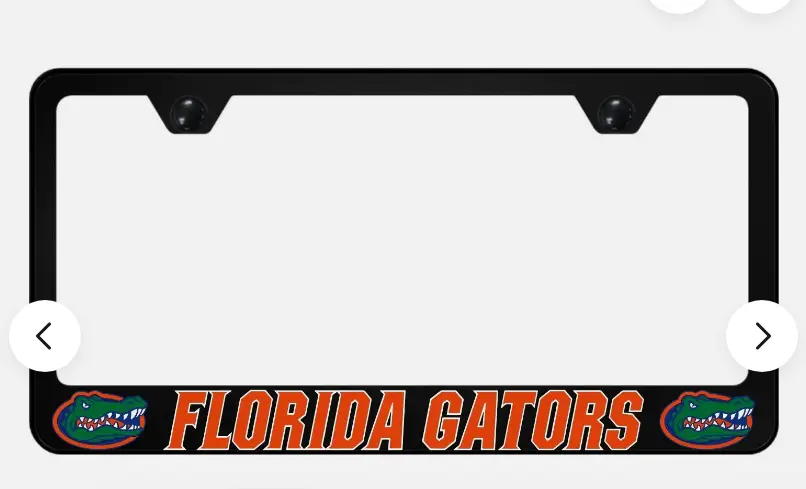
When purchasing a new car, dealerships often attach decorative license plate frames, which could violate HB 253. To avoid fines or jail time, vehicle owners should ensure their plates meet state requirements and remove any non-compliant frames or decorations before driving.
Under HB 523, the decorative frame from dealerships could result in a $500 fine, court costs, or jail time.
A car dealer must not have contributed politically to someone’s political campaign. The ”new” enhanced law also jeopardizes the manufacturers of such devices (license plate frames).
“License Plate Obscuring Device.”
Florida Statutes is amended, and subsection (1) of that section is republished to read: It is unlawful to alter motor vehicle registration certificates, license plates, or temporary license plates, or to obscure license plates.
A person may not alter the original appearance of a vehicle registration certificate, license plate, temporary license plate, or validation sticker.
The law makes clear the parameters set forth by the enhanced law. It goes on to state: whether by mutilation, alteration, defacement, or change of color or in any other manner.
A person may not apply or attach a substance, reflective matter, illuminated device, spray, coating, covering, or other material onto or around any license plate. “The term around includes decorative license plate frames. Such an act could cost a motorist $500 and or jail time. Now, who do you think a “discretionary” cop is most likely to take to jail for such a violation? An African American or a White person? The Jeopardy music is playing in the background. Who is?
Penalties:
Second-degree misdemeanor: Purchasing or possessing such a device.
First-degree misdemeanor: Manufacturing, selling, or distributing such a device.
Second-degree misdemeanor (e.g., knowingly altering or obscuring a license plate or possessing a license plate obscuring device):
Punishable by up to 60 days in jail, as per Florida Statutes. 775.082.

Miami-Dade Police Major Aaron Campbell Profiled.
Stopping motorists based on a license plate issue is not a new law-enforcement tactic. Such a tactic is like the “Broken Tail Light” ruse.
For many, it’s easy to recall the obscure license plate incident involving Miami-Dade Police Major Aaron Campbell. On April 05, 1997, a Black off-duty police officer named Aaron Campbell got profiled and pulled over by a White Orange County deputy.
On April 09, 1997, Police Major Aaron Campbell was driving north on the FL Turnpike in his new Ford Explorer toward a vacation home he was building in Orlando. Orlando Deputy Corporal Richard Mankewich spotted Campbell, at which time he pulled Campbell over. Corporal Mankewich told Campbell why he stopped him. Campbell told Mankewich, “I follow the law.” He requested to speak with a supervisor.
Mankewich explained to Campbell that he would cite Campbell. Campbell became belligerent and snatched his driver’s license back from Mankewich. As two other deputies arrived at the location, one tried a sneak attack on Campbell from the back. Campbell repelled the sneak attack. The Major had a flashback to the days of slavery and slave patrols. He began running like Kunta Kinte.
Eventually, Mankewich and his crew captured Aaron (Kunta) Campbell. Why are you running, Black man? Don’tDon’t run.
This incident is all about a cop profiling a Black motorist. Major Campbell did explain to Mankewich and his crew at the time of the incident. The basis for the traffic stop was the type of vehicle he was driving in the Orlando area. That was a fact at the time.
Corporal Richard Mankewich falsified his police report by claiming he pulled over Campbell for changing lanes without signaling. During the traffic stop, Campbell contended that Mankewich profiled him and that he did, in fact, use his indicator before changing lanes.
Corporal Richard Mankewich, a Colorful Hothead Character.
Corporal Richard Mankewich falsified his police report by claiming he pulled over Campbell for changing lanes without signaling. During the traffic stop, Campbell contended that Mankewich profiled him and that he did, in fact, use his indicator before changing lanes.
How do you know that Mankewich falsified his police report?
In May 1998, Campbell’s license plate case went to trial. 1998 was the same year Representative Johanna Lopez came to America from Puerto Rico. She is a clueless bimbo. She’s just farting in the wind and passing time on the people’s dime. She doesn’t understand America.
Legal Outcome
Traffic Stop Legality: The Circuit Judge presiding over the trial found the initial traffic stop illegal.
Verdict: In April 1998, a jury acquitted Campbell of two felony counts of battery on a law enforcement officer.
Conviction and Sentencing: The jury found him guilty of two misdemeanor counts of resisting arrest without violence. He was sentenced to one year of probation and ordered to perform community service, avoiding jail time because he had no prior criminal record.
Internal Consequences: The Miami-Dade Police Department suspended Campbell without pay after the arrest and conducted an internal investigation. A state board later pursued a complaint against his law enforcement license, questioning his “moral character””.
What Has Corporal Promoted to Sergeant been Up to?
Mankewich’s career with the Sheriff’s Office began in 1991. He has been praised as one of the department’s most aggressive cops.
A female deputy, Mankewich, filed a sexual-harassment complaint with the federal Equal Employment Opportunity Commission on Tuesday, alleging that the veteran deputy repeatedly directed sexually suggestive remarks at her.
One time when she asked for vacation time, she said Mankewich told her, “Tighten your clothes, and you’ll get it.”
After detective Webb-Edwards had changed her hair color, Mankewich allegedly said, “A woman who changes her hair color has issues at home.”
Mankewich, “The Most Aggressive Cop” Murdered a Black Man.
Earlier this year, 2004, Mankewich was cleared in the death of 26-year-old Marvin Williams. Marvin Williams was unarmed when Mankewich chased him on foot. Mankewich shot Williams in the Parramore neighborhood. He thought he was a murder suspect. Mankewich murdered the wrong man. As usual, they exonerated him. His exoneration came after the shooting enraged members of the black community.
A Decorative License Plate Can Get You Killed In Florida.

“Think globally, act locally.”
It is crucial to be forward-thinking but not a forward person. “Be kind to everyone you meet because each carries his heavy burden…” Plato.
Embrace the three Constants: change, justice, and rightness.
The thought police are busy at work trying to suppress free speech. If allowed their march to madness, they will arrest your very thoughts.
Free Speech is thy Lord.’